
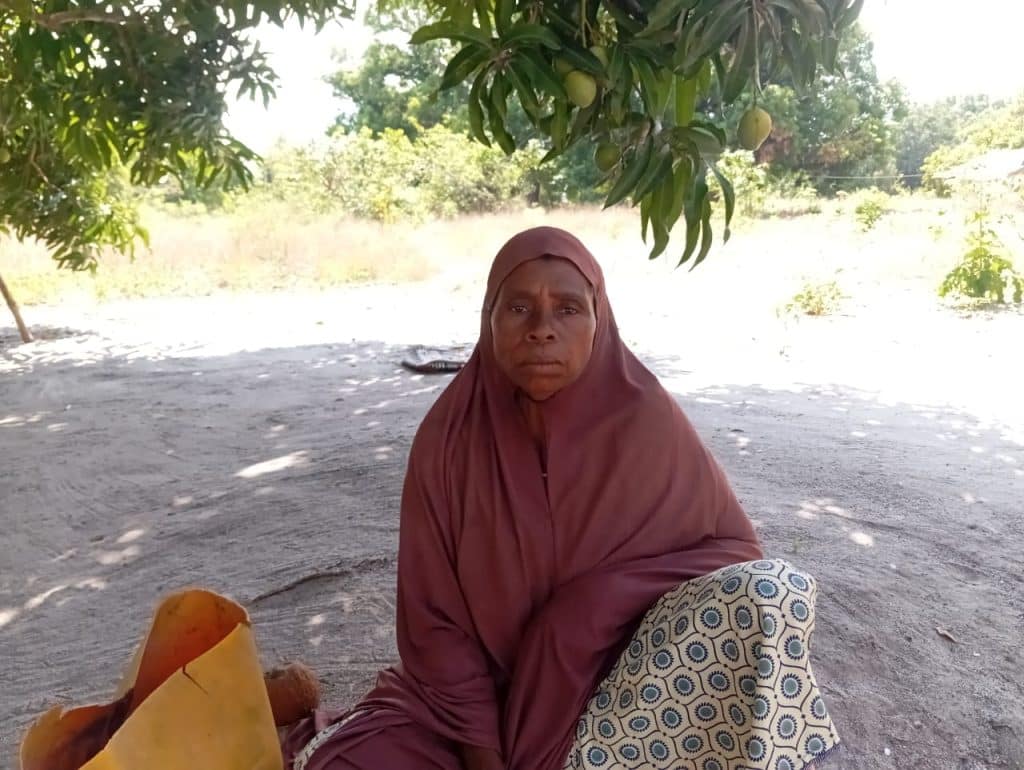
The Story of Manasha Saidi: A Mother of Seven Struggling for Survival and Opportunity
Manasha Saidi is a 48-year-old woman and the mother of seven children. Her story reflects the harsh reality faced by many families living in extreme social and economic vulnerability, where access to stable work, income, and basic opportunities remains out of reach.
Manasha does not own a business and has no formal employment. In order to support her children, she relies on physically demanding and unstable labor, such as small-scale fishing and working in salt pans. These jobs require long hours of hard work, offer very low income, and depend heavily on weather conditions. Despite the difficulty, they are the only options available to her to provide food for her family.
Beyond the physical hardship, Manasha also faces social exclusion. Without financial resources, higher education, or external support, she is unable to start any activity that could improve her family’s living conditions. Although she is willing to work and contribute more, opportunities simply do not reach people in her situation.
Some of Manasha’s children have completed secondary school, reaching the 12th grade, yet they remain unemployed. According to her, the lack of jobs affects poor families the most—those without money, influence, or connections. When rare employment opportunities arise in the community, they are often given to children from wealthier families, leaving vulnerable households behind.
Manasha is not asking for charity. She is asking for opportunity. She explains that even a simple job would allow her children to work and help support the family. One of her greatest fears is the coming rainy season. During this period, salt pans often close, meaning her children will lose their only source of income. When this happens, the family’s situation becomes even more critical, and suffering increases.
In the past, Manasha also tried to survive through subsistence farming. However, she often returned home without any harvest—sometimes without food for her children and occasionally without anything for herself. Unpredictable weather, lack of tools, and physical exhaustion made farming an unreliable solution.
The story of Manasha Saidi is not just about one woman. It represents the lives of countless mothers who silently struggle every day to keep their children fed and hopeful. Her experience is a clear call for effective public policies, local job creation, support for women-headed households, and genuine social inclusion.
This is the story of Manasha Saidi—a resilient, hardworking mother who continues to fight every day so that her children do not go hungry and can one day have a better future.